Have you ever emptied your pocket change and wondered if a simple nickel could change your life forever? The 2006 Jefferson Nickel has sparked wild rumors online, with some claiming it can be worth an astonishing $150 million. But is that real, or just another internet myth? Today, we’re diving deep into the world of rare mint errors, “Full Steps,” and the secret details that collectors hunt for.
🧐 What’s a Regular 2006 Nickel Worth?
Let’s be real: 99.9% of 2006 Jefferson Nickels you find in circulation are worth exactly 5 cents — no more, no less. The U.S. Mint produced hundreds of millions of these coins at the Philadelphia and Denver mints. However, it’s the tiny fraction of errors and pristine, never-circulated specimens that make numismatic headlines. That’s where the magic (and potential fortune) hides.
🏛️ Design Breakdown: Jefferson & Monticello
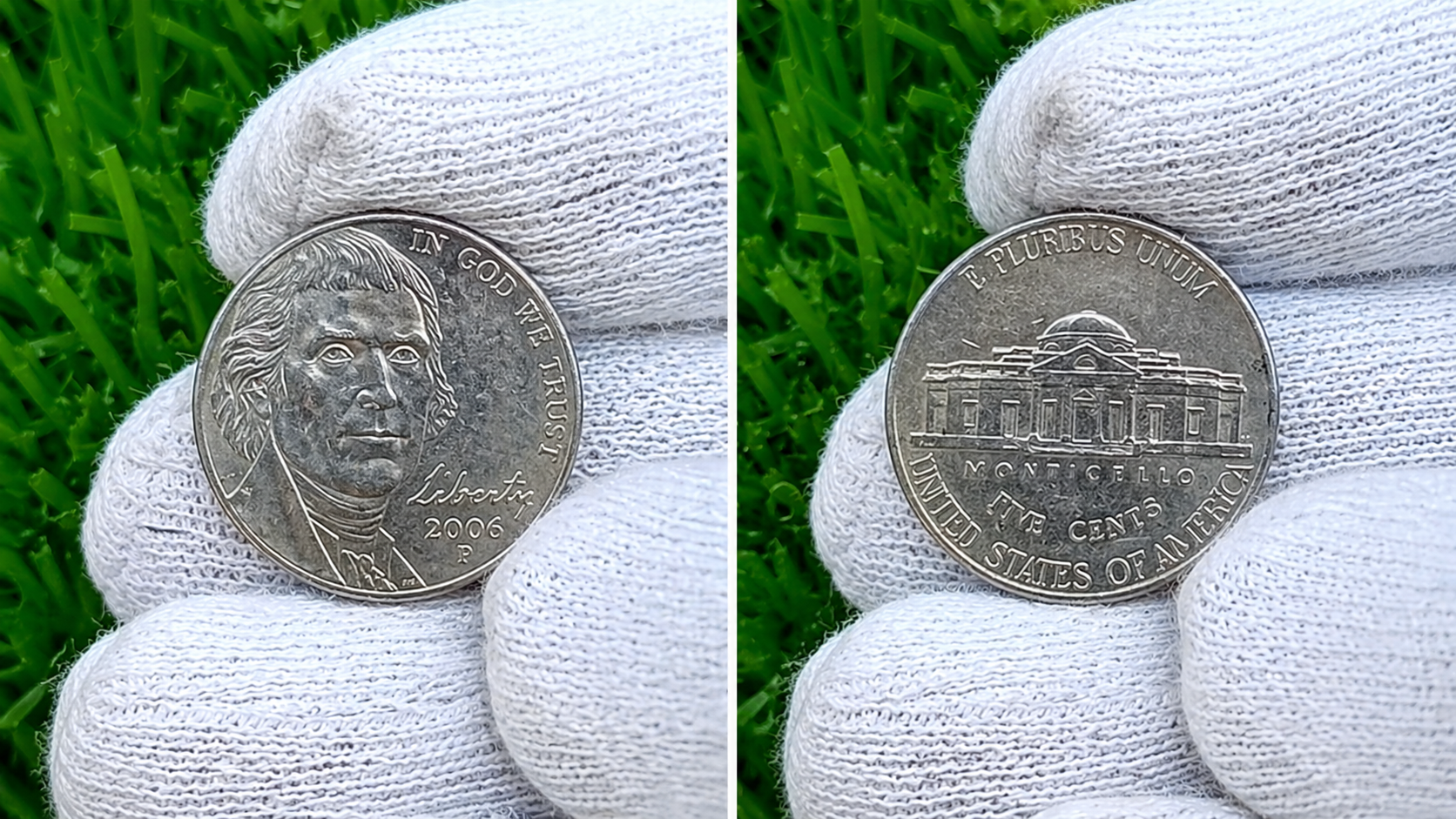
Designed by Jamie Franki, the 2006 nickel features a striking forward-facing portrait of Thomas Jefferson on the obverse (front). Flip it over, and you’ll see the iconic Monticello — Jefferson’s Virginia estate. What drives collectors wild is the term “Full Steps” (FS). This means the six horizontal steps on Monticello’s front entrance are completely distinct and unbroken — no scratches, no wear. A Full Steps designation can multiply a coin’s value by 100x or more!
🔍 Mint Marks Decoded: P, D, S — What’s the Difference?
On the obverse, just below the date, you’ll find a tiny letter. That’s the mint mark. Here’s what each means for the 2006 nickel:
- P (Philadelphia) — Most common. Business strikes for everyday use.
- D (Denver) — Also common. Slightly lower mintage but still face value unless error.
- S (San Francisco) — Proof coins only. These have mirror-like fields and frosted details. If an S-proof has a major error, we’re talking serious money.
Pro tip: Look for coins with NO mint mark — that usually means Philadelphia as well, but on some rare years, missing mint marks are errors themselves. (For 2006, that’s unlikely, but always check!)
💎 The Secret Sauce: Mint Errors That Skyrocket Value
Here are the rare mint mistakes that can turn a 5-cent coin into a collector’s dream. Grab a magnifying glass (10x or stronger) and inspect your nickel for these:
- 🔄 Double Die (DDO or DDR) — Letters, numbers, or Jefferson’s face appear doubled. Look at “LIBERTY” and “2006”.
- 🎯 Off-Center Strike — The design is shifted to one side. Even 10% off-center adds value; 50% off-center can be worth hundreds.
- ⚙️ Broadstrike — The coin is wider than normal because the retaining collar failed. Looks like a “mushroom” edge.
- 🧲 Missing Clad Layer — The outer copper-nickel layer is partially or completely missing, revealing the inner copper core. Very rare and valuable.
- 🔪 Die Cracks & Cuds — Raised bumps or cracks across the coin’s surface from a damaged die.
⚠️ Caution: If you find any of these, do NOT clean the coin! Cleaning destroys collector value. Put it in a protective flip and call a professional.
🏆 The $150 Million Rumor — Truth or Clickbait?
Let’s cut through the noise. No 2006 Jefferson Nickel has ever sold for $150 million. In fact, the most expensive coin ever sold at auction is the 1933 Double Eagle ($18.9 million), followed by the 1794 Flowing Hair Silver Dollar ($10 million). The $150 million figure floating around social media is completely fabricated — likely a mix of crypto-bro hype and wishful thinking.
But here’s the real good news: A 2006 Jefferson Nickel with Full Steps + Double Die + MS67+ grade from PCGS or NGC can sell for $3,000 to $12,000. That’s still a massive return on a 5-cent coin! And if you have a 2006-S Proof with a rare error, values can exceed $20,000 at major auctions like Heritage or Stack’s Bowers.
🛠️ How to Grade Surface Quality (Even As a Beginner)
Professional grading uses the Mint State (MS) scale from 60 to 70. Here’s a simple checklist to evaluate your coin at home:
- Luster: Does the coin have its original cartwheel shine? Dull = circulated.
- Contact marks: Tiny bag marks are normal, but heavy scratches = lower grade.
- Full Steps check: Use a magnifier. Can you see 6 distinct horizontal lines on the Monticello steps? If yes, congratulations — you have an FS nickel!
- Eye appeal: Is the toning natural? Avoid rainbow-colored coins unless they’re certified (some are artificially toned).
When in doubt, submit your coin to NGC or PCGS (costs $20–$40 plus shipping). A certified slab (holder) protects the coin and proves authenticity to buyers.
📢 Where to Get Your Coin Appraised (For Free or Paid)
✅ Professional Grading Services:
NGC (Numismatic Guaranty Company) — ngccoin.com
PCGS (Professional Coin Grading Service) — pcgs.com
✅ Local Options:
Visit a reputable local coin shop (LCS). Avoid pawn shops unless they specialize in numismatics.
✅ Online Communities:
Reddit’s r/coins, CoinTalk, or Facebook coin groups — post clear photos for expert opinions (free, but not official).
Never sell a potentially rare coin before getting a professional opinion!
🕵️ Real-Life Success Stories
A collector in Ohio found a 2006-D Nickel with a massive off-center strike (about 40%) in a roll from the bank. PCGS graded it MS62, and it sold for $1,700 on eBay. Another seller discovered a 2006-P Double Die Reverse (DDR) in pocket change — it wasn’t Full Steps, but still brought $850 at auction. These aren’t millions, but they’re life-changing finds from ordinary pocket change.
📦 Final Checklist: Don’t Spend This Nickel Until You Check These 5 Things
- ✅ Look at the mint mark — is it P, D, or S? Proof S coins are easiest to spot (mirror background).
- ✅ Inspect Monticello’s steps — are all 6 lines visible and unbroken?
- ✅ Search for doubling on “IN GOD WE TRUST” and “LIBERTY”.
- ✅ Check the edge — is it smooth? Broadstrike coins have no reeded edge (but nickel edges are smooth anyway — so focus on diameter!).
- ✅ Compare your coin to high-resolution images on PCGS CoinFacts or NGC VarietyPlus.
🎯 Bottom Line
Your 2006 Jefferson Nickel probably isn’t worth $150 million — but it could be worth hundreds or thousands if you know what to look for. The real treasure is in the errors: double dies, off-centers, and Full Steps. Don’t spend your spare change until you’ve examined it under a magnifier.
Happy hunting, and may your pocket change surprise you! 🪙
⚖️ Full Disclaimer: This article is for informational purposes only. Coin values are speculative and based on past auction results. The author and website are not liable for any financial decisions made based on this content. Always seek professional advice from NGC, PCGS, or a certified numismatist. The $150 million figure is an internet rumor not supported by any verified sale — treat it as entertainment.