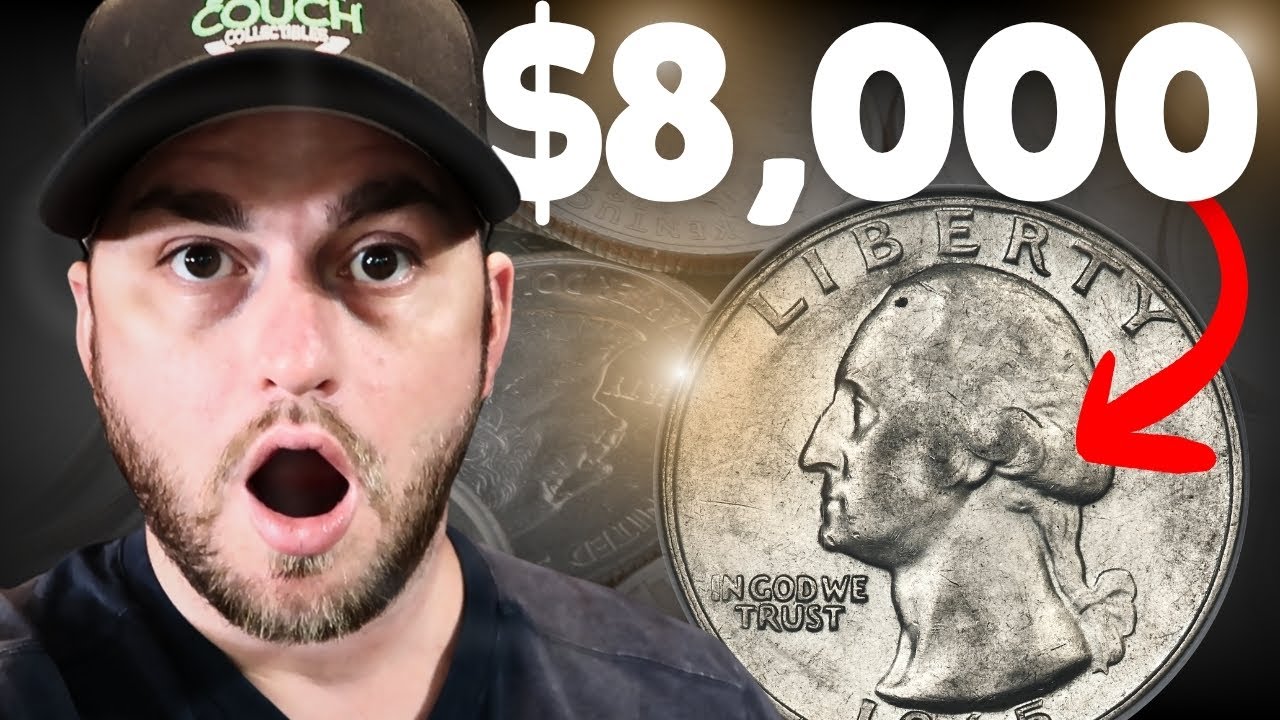
Do you have a rare 1965 quarter? If you’ve ever cracked open a roll of coins from the bank or inherited a jar of pocket change, this is the article you need to read. At first glance, the 1965 Washington Quarter seems ordinary — it’s one of the most common dates out there. But hidden among billions of clad coins are specific mint errors and high-grade specimens that have sold for thousands — sometimes over $11,000 — at auction.
In this guide, I’ll walk you through the most valuable errors, what they look like, and how to spot them using techniques you can do at home. Let’s dive in.
1️⃣ The Basics: Why 1965 is special
Before 1965, U.S. quarters were made from 90% silver. But due to rising silver prices and a national coin shortage, the U.S. Mint switched to clad composition (copper-nickel over a pure copper core) starting in 1965. This change makes the 1965 quarter a transitional year — and transitional errors are extremely collectible. Some 1965 quarters were accidentally struck on leftover silver planchets from 1964. If you find one, you’ve hit a jackpot.
📌 Pro tip from Couch Collectibles:
“The way you can tell if it’s silver or not is very easy — weigh your coin and look at the edge. A silver coin has a solid, bright white edge, while a clad coin shows a distinct copper stripe.”
2️⃣ The Most Valuable 1965 Quarter Errors (With Real Auction Results)
Below is a breakdown of actual error coins sold at auction. Use this as your checklist when searching through pocket change.
| Broad Strike | Stretched, expanded rim beyond normal collar | $129 | |
| Double Curved Clip | Two small bite-like curves missing from the edge | $61 | |
| Doubled Die Obverse (AU58) | Doubling on “LIBERTY”, “IN GOD WE TRUST”, or date | $360 – $488 | |
| Doubled Die (AU55 – lower grade) | Same doubling, lower condition | $575 | |
| Mint State 65 Doubled Die | Near-perfect surfaces with clear doubling | $720 | |
| Struck on a Silver Dime Planchet | Quarter design on a tiny silver disc (underweight) | $1,600 | |
| Silver 1965 Quarter (Transitional Error) | Silver edge, no copper stripe; weighs ~6.25g | $8,000+ | |
| Mint State 68 Regular Strike | Flawless gem condition (extremely rare) | $11,000 | |
| SMS Specimen 68 Cameo | Special Mint Set with frosted design and mirrored fields | $2,640 |
3️⃣ Deep Dive: The $11,000 Grade Difference
You might think a coin that looks “pretty good” is worth a lot — but condition (grade) is everything. One of the most shocking examples in coin collecting comes from the 1965 quarter:
- Mint State 68 (MS68) – Sold for $11,000 because only a handful exist at this level.
- Mint State 65 (MS65) – Also a beautiful coin, but it sold for only ~$40.
Three grades apart = a difference of nearly $11,000. This is why I always recommend protecting your best coins and sending them to professional grading services like PCGS or NGC if you suspect they’re high-end.
✅ Quick self-test: Look at your 1965 quarter under a magnifying glass. Is there any doubling on the letters? Any missing metal on the rim? A strange silver edge? If yes, you might be holding hundreds — or thousands — of dollars.
4️⃣ The “Special Mint Set” (SMS) Quarters – A Hidden Gem
In 1965, the Mint didn’t produce regular proof sets. Instead, they made Special Mint Sets (SMS) with a unique satin-like finish. These quarters are not circulated and often have sharper strikes. But here’s what most people miss: even within SMS quarters, errors exist.
One incredible example: an SMS 1965 quarter with a “strikethrough error” — a string or piece of debris fell onto the die before striking. The result? A strange cross-like mark across Washington’s head. That unique error sold for $228 because it’s one-of-a-kind.
5️⃣ Wrong Planchet Errors – The Rarest of the Rare
Imagine a quarter design stamped onto a tiny dime. That’s exactly what happened with two major errors:
- 1965 Quarter struck on a Roosevelt dime planchet: Only 4.2 grams (quarter should be 5.67g). Sold for $360.
- 1965 Quarter struck on a 5-cent (nickel) planchet: Weird size and metal composition. Sold for $348.
- 1965 Quarter on a 1964 silver planchet: This is the Holy Grail — a silver quarter from a year when no silver quarters were supposed to exist. One sold for $8,000 at auction.
How to detect a wrong planchet? Weigh your coin. A standard 1965 clad quarter weighs 5.67 grams. Anything significantly less (or more) could be a major error.
6️⃣ Your 3-Step Checklist for Hunting 1965 Quarters
Step 1: Inspect
Check the rim (broadstrike), letters (doubling), and surface (strikethroughs).
Step 2: Weigh
Use a digital scale. 5.67g = clad. ~6.25g = silver. ~4.2g = dime planchet.
Step 3: Grade & Protect
If it looks Mint State (no wear), put it in a flip and consider professional grading.
Final Thoughts: Start Searching Today
The 1965 quarter is still in circulation. Banks have them, old coin jars have them, and most people overlook them. But now you know exactly what to look for: broadstrikes, doubled dies, silver edges, wrong planchets, and high-grade specimens. Whether you find a $61 clipped quarter or an $11,000 gem, the hunt is part of the excitement.
Happy hunting, and may your next roll of quarters hold a hidden fortune.
“Knowledge is the most valuable coin — but finding a silver 1965 quarter doesn’t hurt either.”
Share this article with a fellow coin collector. Follow for more error coin guides.